
True Asian Rice Purity Test
If you belong to Asia and have seen friends posting screenshots of an asian purity test and arguing over who scored higher, you have run into the True Asian Rice Purity Test. It looks familiar because it borrows its layout from the Rice Purity Test, but it plays by different rules, and most write-ups online get those rules wrong.
Here is the interesting part that confuses people most of the time. On the classic test, checking more boxes lowers your score. On the True Asian Test, checking more boxes raises it. The whole thing is reversed, and once you know that, then everything makes sense.
What the True Asian Rice Purity Test Is
The True Asian Test is a parody quiz built on the format of the classic Rice Purity Test. It was created by Liang Pan. Instead of measuring innocence or life experience, it measures how many stereotypically Asian household and upbringing experiences you can relate to.
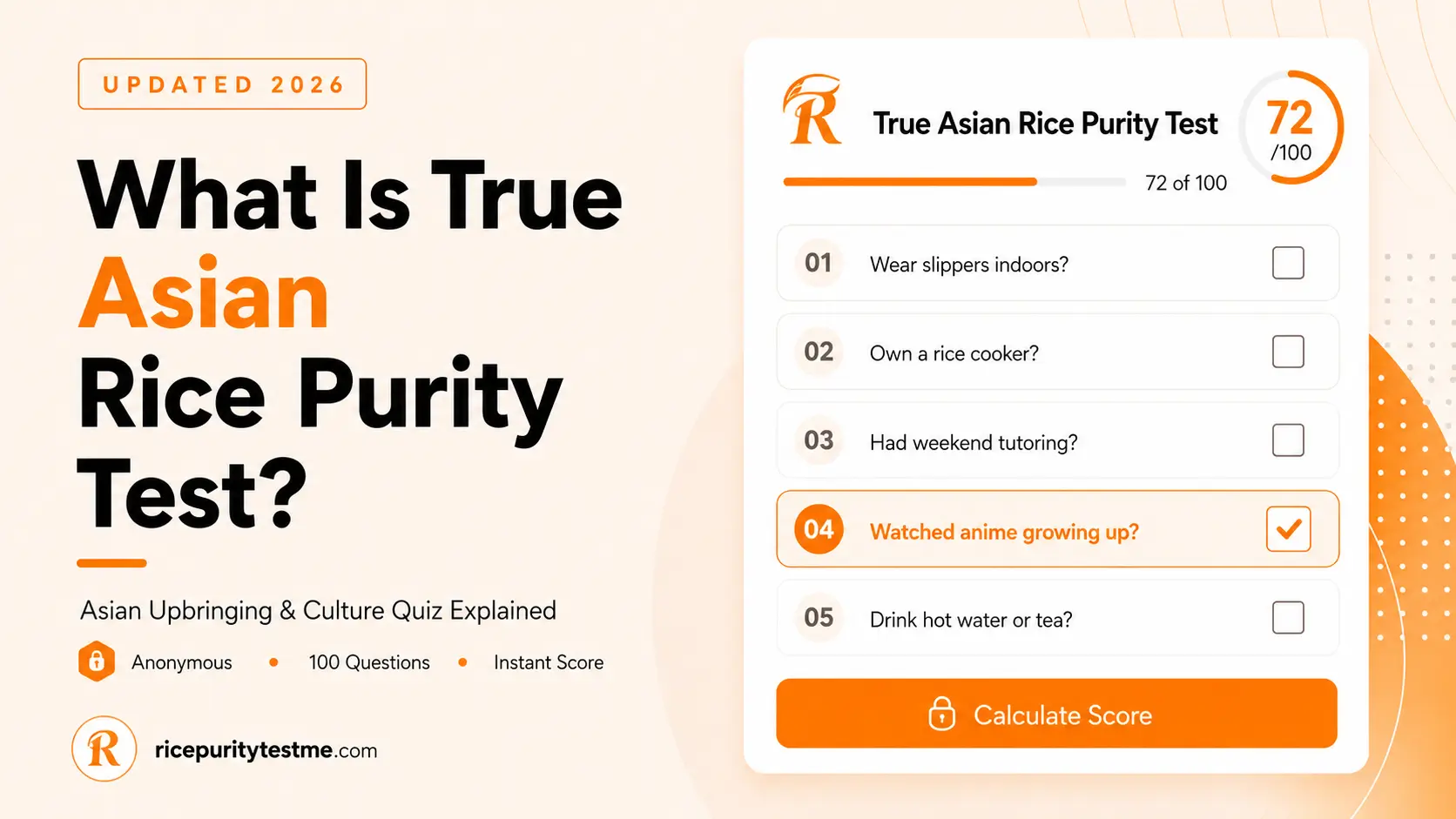
You go down a checklist and tick every item that applies to you. The more you tick, the higher your percentage will be and the more asian your belonging proves. It leans into humor about strict parents, tutoring, food habits, and growing up in an Asian household, so it lands hardest with people who lived those things. If the food and everyday-habit questions are your favorite part, the Brown Rice Purity Test takes a lighter, food-and-culture-focused approach.
It is not a scientific measure of identity or heritage. There is no governing body behind it, no data collection about your ethnicity, and no real meaning to the number. It is a shared-experience meme that spread through TikTok and group chats, which is exactly why the how asian are you framing caught on.
How the Scoring Works (and Why It Confuses People)
This is where accuracy matters, because several popular articles describe the scoring backwards by copying the logic of the classic test.
On the True Asian Test, you check off every item you have actually done or experienced. Every box you tick pushes your total higher, and the site converts that tally into a percentage at the end. Higher means you relate to more of the list. The site adds a joke warning that scoring below 90 percent means you bring dishonour to your family, which is played for laughs, not as a real threshold.
| Test | You check items that... | Higher score means |
|---|---|---|
| Classic Rice Purity Test | you have done | less pure, more life experience |
| True Asian Rice Purity Test | you relate to | more relatable Asian upbringing experiences |
If you see a guide telling you that a high score on the True Asian Test means least experienced or most pure, that guide is applying the old scoring by mistake. The two tests share a look, not a meaning.
What Kind of Questions It Asks
The checklist runs to dozens of items, all pulled from everyday life rather than the milestone-and-taboo questions of the classic. They cluster into a few loose themes.
Home and daily habits:
- No shoes worn inside the house
- Eating rice almost every day and owning a rice cooker
- Drinking warm or hot water in the morning
- Keeping a stash of plastic bags at home
School and parents:
- Tutoring in primary or high school
- Saturday language school
- Learning piano, violin, or cello
- A curfew and getting asked where you were and who you were with
Culture and pop culture:
- Watching anime or listening to K-pop, C-pop, or J-pop
- Being able to do the asian squat with feet flat
- Getting asian flush after a small amount of alcohol
- Believing in household superstitions
The tone throughout is affectionate and self-deprecating, which is why it reads as a bonding exercise rather than a real assessment. People share results to say same, not to compete on virtue.
True Asian Test vs the Classic Rice Purity Test
They are easy to mix up, so here is the short version of how they differ.
| Feature | Rice Purity Test | True Asian Rice Purity Test |
|---|---|---|
| Origin | Rice University student culture | Parody by Liang Pan |
| Measures | Innocence and life experience | Relatable Asian upbringing |
| Checking a box | Lowers your score | Raises your score |
| Tone | Mixed, sometimes serious | Comedic throughout |
| Best score to brag about | A high number, more innocent | A high number, more relatable |
The classic started as a self-scored survey in Rice University's student newspaper in the 1920s and later grew into the 100-question format that went viral on TikTok. The True Asian Test is a much more recent spin-off that kept the checkbox design and swapped in cultural in-jokes.
Should You Take It Seriously?
No, and that is the point. The True Asian Test is entertainment. It cannot tell you whether you count as Asian, and questions like am I asian do not have a real answer hiding inside a checkbox quiz. Identity is not a percentage.
It is worth being aware that purity style tests, including the classic, have been criticized for the way they frame experience and culture. Treat the True Asian Test the way its creator intended, as a lighthearted way to laugh about shared experiences with friends, and it holds up fine. Read too much into the number and you are giving a meme more weight than it can carry.
For a separate reflection on racial assumptions rather than cultural identity, the Racism Rice Purity Test asks about bias and everyday behavior.
You may also like
Explore related versions and guides: Brown Rice Purity Test: Food & Culture Quiz and Performative Rice Purity Test: Quiz 2026.